

There's a kind of analyst that every leadership team quietly wishes they had in the room.
Not the one with the polished deck and the rehearsed talking points. The one who, when a senior leader asks something completely unplanned mid-meeting, doesn't reach for their apology. They reach for their laptop. They pull the data themselves, build the answer on the spot, and keep the conversation moving as if nothing happened.
That person isn't magic. They just learned to talk to data directly instead of waiting for someone else to translate it for them.
Most analytics professionals know this gap exists. They've felt it in meetings, in delayed reports, in the quiet frustration of depending on a technical team just to ask a simple question. SQL and Python are what close that gap. Not as engineering languages, but as the fastest route from a question to an answer, with no waiting, no email chains, and no one else holding the keys.
The difference between an analyst who reports on what happened and one who can figure out what's happening right now comes down to exactly these two skills.
The Evolution of Analytics: Beyond Basic Reporting
The analytics landscape in 2025 and 2026 is moving away from traditional requirement gathering. Organizations are no longer looking for someone to simply document what happened. Instead, they need a strategic partner who can drive digital transformation. As companies move toward cloud-native environments and complex data architectures, they expect you to handle large-scale datasets independently.
Relying on IT intermediaries creates a bottleneck that modern businesses cannot afford. Mastering the combination of SQL and Python for analytics careers is now the foundational standard for professionals bridging the gap between business stakeholders and technical developers. By owning the data extraction and transformation process, you move from the sidelines of digital innovation to the centre of the strategic roadmap.
Why SQL is the Non-Negotiable Foundation
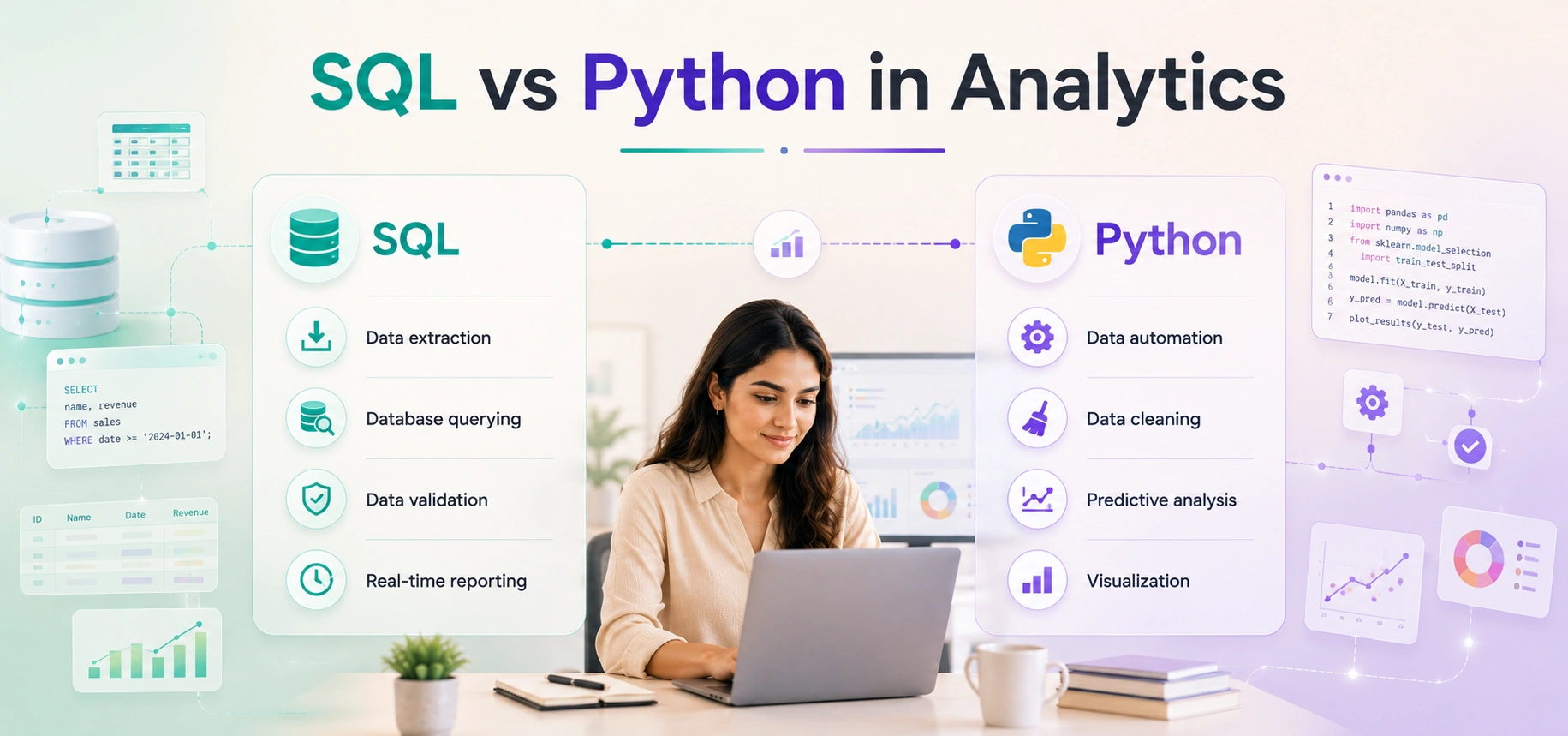
SQL remains the most critical tool in your technical arsenal. It is the primary language of data, allowing you to speak directly to the source of truth without a translator. When you use SQL for data analysis, you gain an immediate level of autonomy that builds massive credibility with your team.
Specific benefits of SQL proficiency include:
- Data Extraction and Querying: The ability to join disparate tables and filter millions of rows to answer urgent business questions in seconds.
- Real-Time Reporting: Building the underlying logic for up-to-the-minute dashboards that reflect the current state of the business.
- Data Validation: Using queries to perform integrity checks, ensuring that your data is accurate and consistent before it ever reaches a stakeholder.
- Faster Turnaround Time: Eliminating the "wait time" associated with IT tickets, allowing you to move from question to insight at the speed of the business.
Why Python Changes Your Career Trajectory
While SQL is for retrieval, Python for analytics jobs is for power and scale. Python allows you to step beyond the rows and columns of a database into the worlds of automation, predictive modeling, and sophisticated visualization. It transforms you from someone who describes the past into someone who can predict the future.
By leveraging specialised libraries, you can handle tasks that would break a traditional spreadsheet. You will use Pandas for high-speed data manipulation, Matplotlib and Seaborn for compelling visual storytelling, and Scikit-learn to build models that identify trends before they become problems.
|
Traditional Manual Tasks |
Python-Enhanced Solutions |
|
Manual Excel updates and tedious data cleaning |
Automated scripts for data transformation and cleaning |
|
Manual parsing of large or disparate files |
Automated parsing of large Excel, CSV, or JSON files |
|
Basic static sales reporting |
Predictive analysis and forecasting for future trends |
|
Manual distribution of reports via email |
Automated email distribution scripts |
Closing the Gap in Data Analytics Skills
There is a widening gap in the market today. Many professionals rely entirely on pre-built BI dashboards. While these tools are useful, they often become a career bottleneck. When a dashboard lacks a specific filter or a certain data point, an analyst without technical depth is stuck.
The industry now demands a versatile skill set. You must pair your soft skills, such as communication and business acumen, with hard data analytics skills. Recruiters are looking for "versatile" professionals who can perform requirements engineering using tools like Jira or Visio, while simultaneously having the technical chops to perform ad hoc analysis on raw data when the dashboard falls short.
The Recruiter’s Lens: Evaluating Technical Depth
As a mentor, I can tell you that hiring managers are looking for more than a certificate. They want to see how you apply these tools to solve high-pressure business problems. "Certificate knowledge" is easy to find, but "hands-on ability" is rare.
Practical Project Depth
In an interview, do not just say you know Python. Describe how you performed financial data reconciliation by comparing multiple datasets to flag mismatches. Explain how you conducted a customer churn analysis to identify risk segments. These real-world applications carry significant weight.
Strategic Career Benefits
-
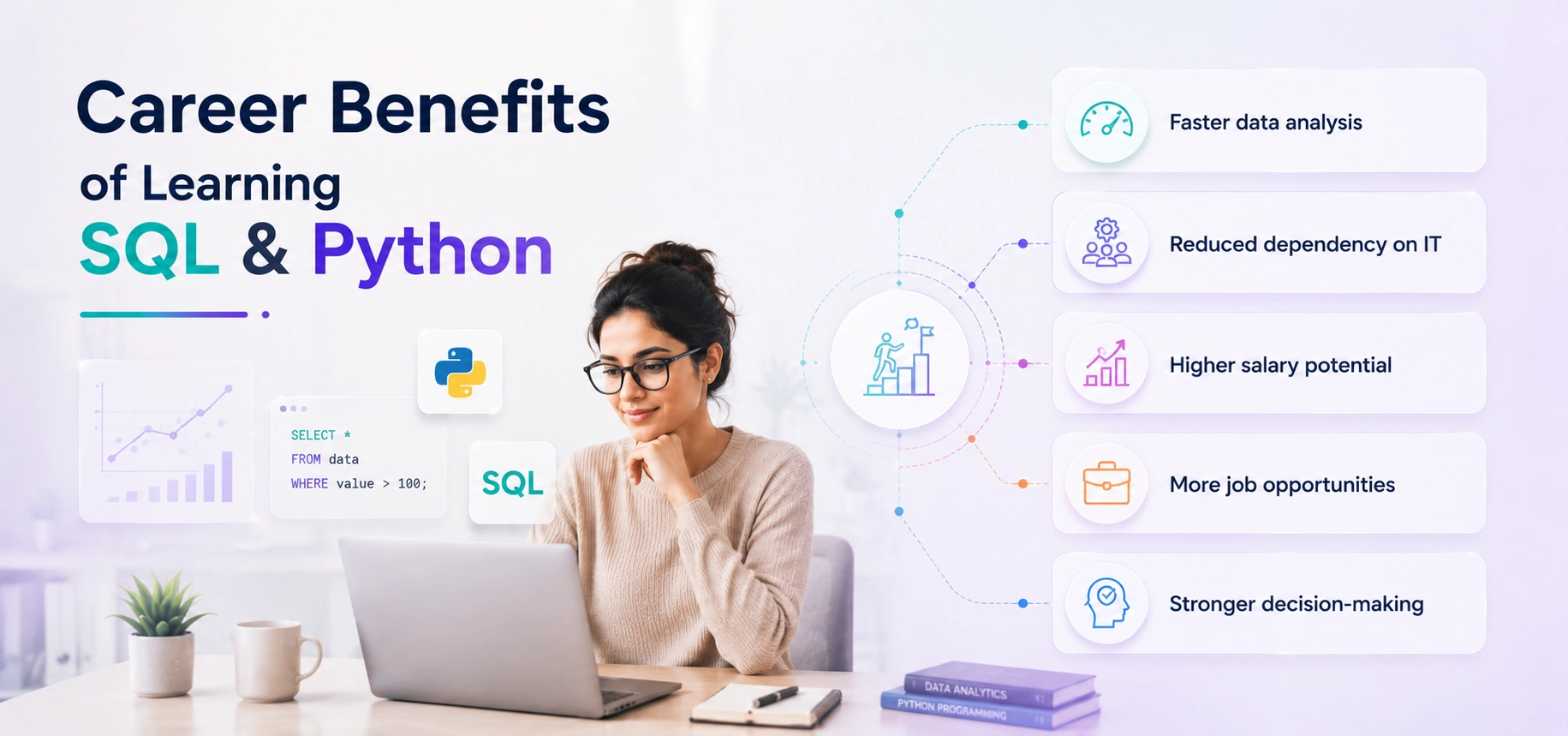
Higher Salary Potential: Professionals who can automate their own workflows and perform advanced modelling reduce overhead and increase the speed of insights, making them more valuable.
-
Broader Job Roles: Technical proficiency opens doors to roles like product analyst or analytics consultant, where you influence the digital roadmap.
-
Better Technical Collaboration: When you understand the underlying logic of a script, you can collaborate effectively with data scientists and engineers on "clean core" data strategies.
Future Outlook: Analytics in the Era of AI and Automation
The outlook for 2025 and 2026 is dominated by AI integration and cloud migration. We are entering the era of "agentic AI," where AI-driven work partners assist with supply chain and procurement. However, these AI agents are only as good as the logic they are given.
This is why SQL and Python remain the core foundation. Agentic AI requires clean, structured data queries and script-based logic to execute tasks accurately. If you understand the fundamental logic of these languages, you can manage the data that fuels these systems. Mastering these technical fundamentals is the only way to protect your long-term career growth in an increasingly automated world.
Also Read: Top AI Tools for Data Scientists (Beyond Python & R)
Conclusion: From Reporter to Problem Solver
Think back to that analyst in the meeting who was paralysed by a static spreadsheet. By committing to building durable analytics career skills, you ensure that you are never that person again. You transform from a passive reporter into a confident, independent problem solver who provides high-value insights on demand.
The shift toward a data-centric world is not a trend: it is a fundamental change in how businesses operate. To remain a strategic partner, you must own the tools of the trade. Start with the logic of SQL and the power of Python, and you will find yourself at the forefront of the next generation of decision intelligence.